🧬 Flask Track Docs

Compliance Events

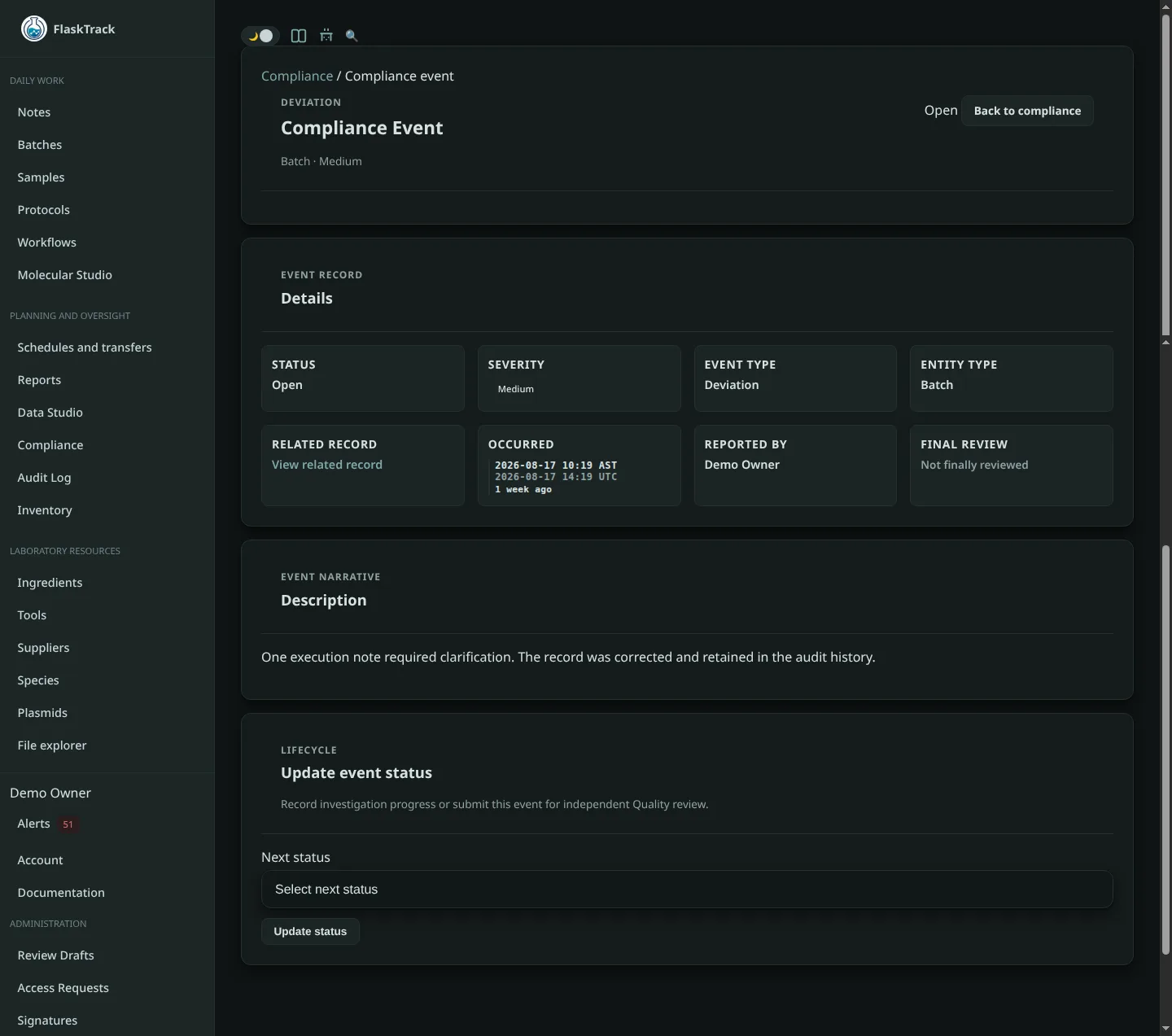
Compliance events record operational incidents, deviations, observations, and corrective actions that occur during laboratory execution.

They provide a structured system for documenting real-world operational issues as they happen, independent of scheduled audits or formal reviews.

Compliance events capture the operational reality of laboratory work, including:

Events become part of the permanent compliance and operational history of the organization.


What Is a Compliance Event?

A compliance event is a structured record describing something operationally significant that occurred during laboratory activity.

Events may document:

Compliance events are intended to preserve factual operational history rather than retrospective interpretation.


Why Compliance Events Matter

Many important operational issues occur outside formal audit cycles.

Without structured event tracking, organizations may lose visibility into:

Compliance events allow organizations to preserve operational awareness continuously rather than only during scheduled audits.


Events vs Audits

Compliance events and audits serve different purposes.

System Purpose
Compliance Events Capture operational incidents and deviations in real time
Audits Perform formal point-in-time compliance evaluations

Events document what happened operationally.

Audits evaluate whether systems and execution remain compliant overall.

Both systems work together to create long-term quality and regulatory traceability.


Event Lifecycle

Compliance events typically follow a lifecycle such as:

  1. Observation
  2. Event recording
  3. Severity assessment
  4. Investigation or review
  5. Corrective action
  6. Historical preservation

Events remain permanently associated with operational history even after resolution.


Creating a Compliance Event

The Compliance Event interface allows users to create structured operational records tied directly to laboratory entities and execution context.

Each event may include:

This creates traceable operational accountability throughout laboratory execution.


Entity Type

Every compliance event is associated with an operational entity type.

Examples include:

The entity type defines the operational context of the event.


Entity Association

After selecting the entity type, users select the specific entity involved.

Examples include:

Events remain permanently linked to the affected operational entity.


Event Types

Event types classify the operational nature of the issue being recorded.

Common event types include:

Structured classification improves:


Incident Events

Incident events describe operational failures or unexpected issues.

Examples include:

Incident tracking helps organizations preserve operational accountability and investigate failures systematically.


Deviations

Deviation events describe departures from approved procedures or expected execution behavior.

Examples include:

Deviation tracking is critical for regulated laboratory environments.


Violations

Violation events document breaches of policy, regulation, or authorization requirements.

Examples include:

Violation events may trigger escalation or formal review workflows.


Near Misses

Near miss events capture situations where an issue was avoided before causing operational impact.

Examples include:

Near miss tracking improves proactive risk management and operational learning.


Corrective Actions

Corrective action events document actions taken to resolve or prevent recurrence of operational issues.

Examples include:

Corrective actions help organizations demonstrate continuous improvement.


Severity Levels

Each event includes a severity classification.

Typical severity levels include:

Severity influences:

Severity should reflect operational impact and compliance risk.


Severity Guidance

Examples:

Severity Example
Informational Minor operational observation
Low Small procedural inconsistency
Medium Temporary environmental excursion
High Significant contamination event
Critical Major biosafety or regulatory breach

Organizations should use the lowest severity that accurately reflects operational risk.


Event Descriptions

Event descriptions should remain:

Good descriptions generally include:

Example:

Power outage caused incubator temperature to decrease by approximately 4Β°C for 45 minutes during active rooting protocol execution.

Descriptions should avoid unsupported conclusions or blame assignment.


Evidence & Attachments

Compliance events may include attached evidence and supporting documentation.

Examples include:

Evidence becomes part of the permanent operational history associated with the event.


Operational Context Integration

Compliance events are deeply integrated with operational execution systems.

Events may reference:

This allows events to remain context-aware rather than isolated administrative records.


Relationship to Alerts

Alerts and compliance events are related but distinct systems.

System Purpose
Alerts Operational notifications and timing awareness
Compliance Events Formal operational issue records

For example:

Together, alerts and events create layered operational oversight.


Regulatory & Compliance Impact

Compliance events may influence:

High-severity or repeated events may indicate systemic operational risk.


Investigation & Root Cause Analysis

Organizations may use compliance events to support:

Because events are linked directly to execution history, investigations remain traceable and evidence-aware.


Runtime Enforcement Integration

Certain events may trigger automated operational behavior such as:

This allows organizations to respond to operational issues proactively.


Immutability & Historical Integrity

Once recorded, compliance events become immutable historical records.

Events:

Immutability is essential for regulatory defensibility and audit integrity.


Audit Visibility

Compliance events may appear during:

Auditors may review:

This improves organizational transparency and traceability.


Reporting & Trend Analysis

Compliance events support operational analytics and reporting.

Organizations may analyze:

Trend analysis supports long-term operational improvement.


Multi-User Accountability

Events preserve complete operational attribution.

Records may include:

This improves accountability across collaborative laboratory environments.


Editing & Management

Authorized users may:

Historical event records themselves generally remain immutable after creation.

This preserves operational defensibility.


Best Practices

Recommended practices include:

Strong event hygiene improves both operational quality and regulatory readiness.


Who Uses Compliance Events?

Technicians

Technicians record:


Scientists

Scientists document:


Compliance Officers

Compliance personnel review:


Administrators & Leadership

Leadership uses event systems to:


Auditors

Auditors review events to verify:

Events provide operational reality beyond formal audit snapshots.


Design Philosophy

Compliance events in Flask Track are designed to be:

The goal is to capture real laboratory operations as they happen while preserving complete regulatory and quality visibility.


Summary

Compliance events provide the operational incident and deviation tracking layer within Flask Track’s compliance system.

By combining structured event classification, severity tracking, evidence attachment, operational context integration, audit visibility, and immutable historical preservation, Flask Track enables organizations to:

Compliance events are not just issue reports β€” they are part of the permanent operational history of laboratory execution.