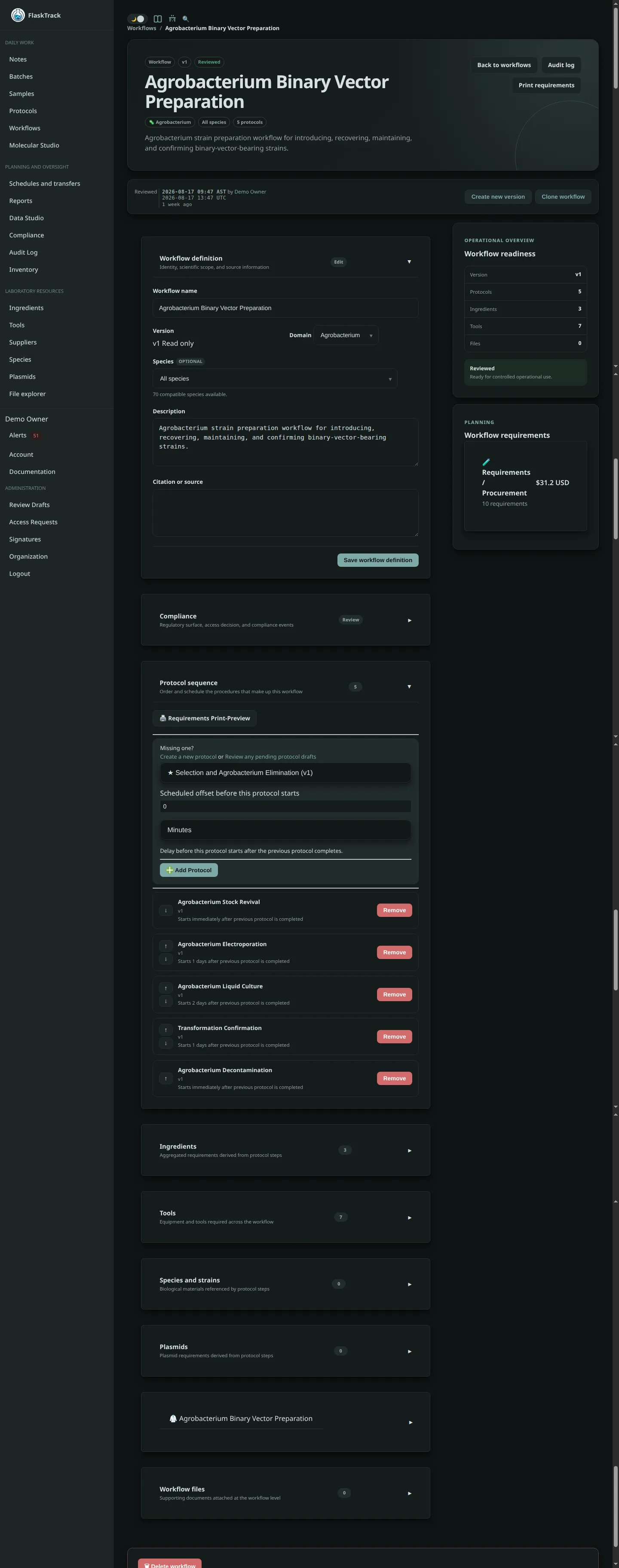
Workflow Detail & Editor
Workflows define how protocols are organized into complete experimental or operational pipelines.
A workflow represents the ordered progression of laboratory procedures over time.
While protocols define how individual procedures are performed, workflows define:
- Which protocols execute
- In what order they occur
- How experimental progression is structured
- How execution schedules are generated
- How batches move through operational stages
Workflows are the orchestration layer connecting laboratory procedures into reproducible operational systems.
Workflow Overview
Workflows act as reusable execution templates for:
- Experimental pipelines
- Manufacturing processes
- Tissue culture propagation
- Transformation workflows
- Fermentation operations
- Sterilization sequences
- Compliance-driven operational procedures
Workflows themselves do not directly execute work.
Instead, workflows are instantiated during batch creation, where they generate the operational structure used for real laboratory execution.
Workflow Metadata
The top section of the workflow defines its operational identity and scope.
Workflow metadata controls:
- Discoverability
- Compatibility
- Reusability
- Species targeting
- Reporting categorization
- Workflow organization
Name
The workflow name identifies the experimental or operational pipeline.
Examples:
- Cannabis Micropropagation Pipeline
- Agrobacterium Transformation Workflow
- Root Induction Sequence
- Fermentation Expansion Workflow
Clear workflow naming improves:
- Searchability
- Reporting clarity
- Audit readability
- Operational standardization
Domain
The domain defines the biological or operational category for the workflow.
Examples may include:
- Tissue Culture
- Fungus
- Agrobacterium
- Fermentation
- General Laboratory Operations
Domains help organize workflows and ensure compatibility with related protocols and operational resources.
Species (Optional)
Workflows may optionally target a specific species.
Species targeting allows organizations to:
- Build highly specialized pipelines
- Restrict incompatible workflows
- Reuse generalized workflows across many species
If no species is specified, the workflow may be used more broadly.
Description
The description provides a human-readable summary of the workflow’s purpose and operational intent.
Descriptions may include:
- Experimental objectives
- Biological context
- Regulatory considerations
- Operational notes
- Expected outcomes
Descriptions appear throughout the platform in workflow listings, execution views, and reports.
Workflow Lifecycle
Workflows typically evolve through operational lifecycle stages such as:
- Draft
- Review
- Approved
- Archived
Organizations may use workflows as:
- Standard operating pipelines
- Experimental templates
- Regulated execution procedures
- Reusable operational systems
Workflow governance improves reproducibility and operational consistency across laboratories.
Cloning Workflows
Workflows may be cloned to create new workflow variants without modifying the original definition.
Cloning is useful for:
- Testing alternative protocol sequences
- Adapting workflows to new species
- Iterating on experimental pipelines
- Preserving approved workflows
- Creating facility-specific variations
- Maintaining regulated baseline procedures
Workflow cloning helps laboratories evolve operational systems while preserving historical traceability.
Protocol Sequence
The Protocol Sequence section defines the ordered protocols that make up the workflow.
Each protocol represents a major operational stage within the overall experimental process.
Examples:
- Media Preparation
- Explant Sterilization
- Culture Initiation
- Expansion Phase
- Root Induction
- Hardening & Transfer
This sequence becomes the operational backbone for execution scheduling.
Adding Protocols
Protocols may be added to a workflow by:
- Selecting an existing protocol
- Creating a new protocol inline
- Reusing shared organizational procedures
Protocols are intentionally reusable across workflows.
This improves:
- Standardization
- Consistency
- Training
- Compliance management
- Scientific reproducibility
Protocol Ordering
Protocols execute sequentially according to their order within the workflow.
Ordering controls:
- Execution progression
- Scheduling generation
- Batch promotion timing
- Dependency management
- Workflow visualization
Protocols may be reordered using workflow controls.
Execution systems preserve this ordering when batches are instantiated.
Workflow Scheduling Logic
Workflow ordering directly affects operational scheduling.
When workflows are instantiated into batches:
- Protocol schedules are generated
- Step timing offsets are calculated
- Execution windows are established
- Alerts and reminders are scheduled
Scheduling may incorporate:
- Fixed timing
- Delayed progression
- Rest periods
- Duration windows
- Protocol dependencies
- Environmental timing constraints
This enables workflows to model real laboratory timelines rather than static checklists.
Removing Protocols
Protocols may be removed from workflows while editing.
Removing a protocol affects future workflow executions only.
Existing batches preserve the workflow structure that existed at the time of instantiation.
This ensures:
- Historical reproducibility
- Execution stability
- Audit defensibility
Workflow modifications never retroactively alter completed execution records.
Workflow Visualization & Procedure Preview
The Procedure Preview provides a read-only representation of the workflow as a continuous operational procedure.
This allows users to:
- Review the complete experimental pipeline
- Verify protocol ordering
- Inspect workflow structure
- Share operational procedures
- Validate execution coverage
The preview dynamically reflects the current workflow configuration and linked protocol definitions.
Shared Workflow Resources
Some workflows may expose consolidated operational resources across all protocols.
Examples include:
- Shared ingredients
- Common tools
- Facility requirements
- Environmental dependencies
This provides a high-level operational overview useful for:
- Inventory planning
- Procurement review
- Scheduling coordination
- Facility preparation
Actual execution tracking remains protocol and step specific.
Workflow Execution Model
Workflows become operational when instantiated into batches.
During batch creation:
- A workflow is selected
- Samples are generated
- Protocol schedules are created
- Step execution timelines are initialized
- Operational tracking begins
Once execution starts:
- Workflow structure becomes fixed for that batch
- Execution history becomes traceable
- Scheduling becomes operationally enforced
Subsequent workflow edits only affect future batches.
Relationship to Protocols
Protocols and workflows serve different operational purposes.
Protocols Define Procedure Logic
Protocols define:
- Instructions
- Conditions
- Materials
- Tools
- Compliance requirements
- Data collection requirements
Protocols describe how individual procedures are performed.
Workflows Define Operational Progression
Workflows define:
- Procedure ordering
- Experimental progression
- Scheduling structure
- Operational sequencing
- Lifecycle flow
Workflows describe how procedures connect together into a complete operational system.
Compliance Integration
Workflows may include compliance-aware operational structure.
Examples include:
- Approval checkpoints
- Restricted operational stages
- Compliance review gates
- Environmental controls
- Required evidence collection
- Regulated workflow segregation
Compliance integration ensures workflows remain operationally enforceable within regulated environments.
Automation & Operational Orchestration
Workflows integrate closely with Flask Track’s automation systems.
Automation capabilities may include:
- Automatic scheduling generation
- Reminder and alert systems
- Delayed execution logic
- Compliance-triggered approvals
- Batch progression automation
- Reporting triggers
- Notification systems
This allows workflows to function as operational orchestration systems rather than static documentation.
Auditability & Traceability
Workflow definitions contribute directly to operational traceability.
Execution systems preserve:
- Workflow versions
- Protocol ordering
- Scheduling context
- Execution history
- Associated compliance data
This ensures laboratories can reconstruct:
- Expected execution structure
- Historical operational flow
- Experimental progression
- Compliance context
even long after execution has completed.
Archival & Deletion
Workflows that have been:
- Used in batches
- Referenced in reports
- Linked to compliance systems
- Included in audit records
may become protected from deletion.
In many cases, workflows are archived rather than permanently removed.
This preserves:
- Historical reproducibility
- Audit integrity
- Operational traceability
Who Uses This Page?
Scientists
Scientists use workflows to:
- Design experimental pipelines
- Structure operational progression
- Standardize laboratory execution
- Improve reproducibility
Technicians
Technicians use workflows to:
- Understand execution sequencing
- Follow operational progression
- Reference upcoming protocol stages
Administrators
Administrators use workflows to:
- Govern operational standards
- Manage regulated procedures
- Coordinate execution systems
- Maintain organizational consistency
Auditors & Reviewers
Auditors review workflows to verify:
- Expected operational progression
- Procedural consistency
- Compliance integration
- Standardized execution paths
Workflows provide the authoritative definition of how laboratory procedures connect together operationally.
Summary
Workflows are the orchestration layer of Flask Track.
They transform individual protocols into structured, repeatable, and scalable laboratory pipelines capable of supporting:
- Batch-scale execution
- Automated scheduling
- Operational traceability
- Regulatory compliance
- Experimental reproducibility
- Long-term auditability
By combining protocol sequencing, scheduling logic, compliance integration, and operational orchestration, workflows provide the framework for managing complex laboratory processes in a controlled and reproducible way.