🧬 Flask Track Docs

Species

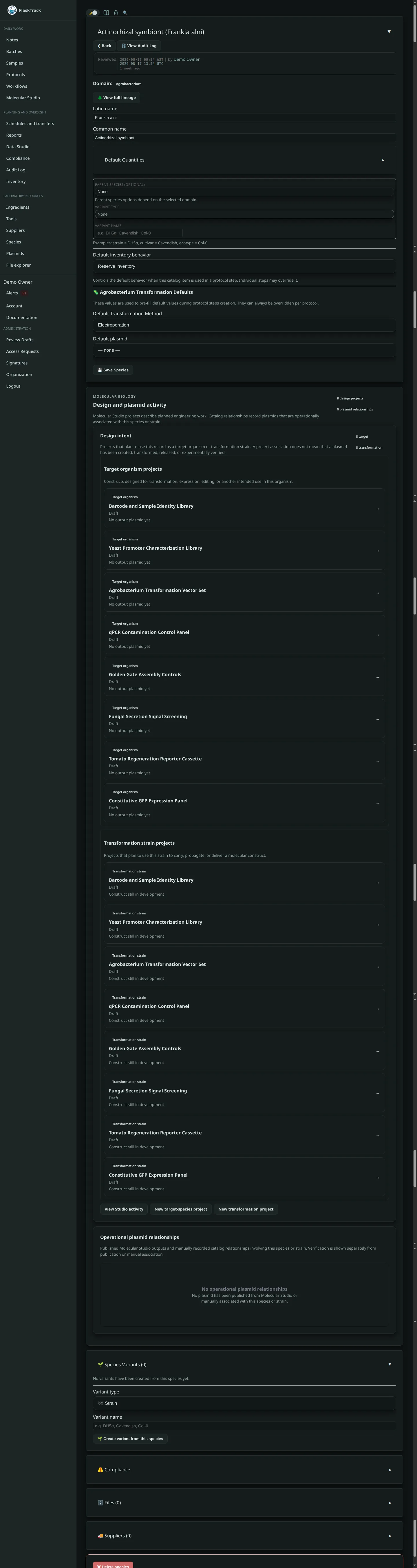
Species define the biological context for laboratory work throughout Flask Track.

They provide structured taxonomic, operational, and experimental metadata used across:

Species records act as reusable biological reference entities that improve reproducibility, traceability, and operational consistency across laboratory execution.


What Is a Species?

A species represents an organism, cultivar, strain, or biological classification used within laboratory workflows.

Species may represent:

Examples include:

Species records provide standardized biological context throughout the platform.


Why Species Matter

Accurate biological modeling is essential for:

Different species may require:

Species records allow Flask Track to enforce and organize these biological relationships consistently.


Species Metadata

Each species contains structured metadata used throughout the platform.


Domain

The domain defines the operational and biological category where the species applies.

Supported domains may include:

Domains influence:

Domains help ensure workflows remain biologically and operationally appropriate.


Latin Name

The Latin name is the primary scientific identifier for the species.

Examples:

Ananas comosus
Arabidopsis thaliana
Pleurotus ostreatus

Scientific naming improves:

Latin names serve as the canonical biological identifier throughout the platform.


Common Name

The common name provides a human-readable label used throughout the interface.

Examples:

Pineapple
Oyster Mushroom
Thale Cress

Common names improve usability while preserving scientific traceability through the Latin name.


Base Species (Optional)

The base species field allows organizations to group cultivars, variants, or strains under a broader biological classification.

Examples:

Variant Base Species
Cavendish Banana Musa acuminata
Col-0 Arabidopsis thaliana

This helps support:

The field is optional and primarily informational.


Strain / Cultivar (Optional)

The strain or cultivar field captures experimental specificity beyond the base species.

Examples:

Cavendish
Col-0
Blue Oyster

This improves:

Cultivar-level distinctions are often operationally significant in biological workflows.


Agrobacterium Transformation Defaults

Species may optionally define default transformation settings used during Agrobacterium-mediated workflows.

These defaults streamline workflow setup and improve operational consistency while still allowing experimental overrides.


Default Agrobacterium Strain

Defines the Agrobacterium strain most commonly used for the species.

Examples:

Defaults help standardize transformation procedures and reduce repetitive data entry.

If no default is configured, no automatic strain is selected.


Default Plasmid

Defines the plasmid or construct most commonly associated with the species.

Examples:

Default plasmids help streamline:

Defaults remain fully overridable during execution.


Files & Biological Documentation

Species records may contain attached biological or operational documentation.

Examples include:

Files attached to species become part of the permanent biological reference record.


Species Usage Throughout Flask Track

Species are deeply integrated into operational execution.

They may be referenced by:

Species context helps ensure laboratory procedures remain biologically appropriate and operationally traceable.


Species & Protocol Compatibility

Protocols may optionally target specific species.

This allows organizations to:

Examples:

Species-aware workflows improve execution reliability.


Species & Sample Traceability

Every sample created within Flask Track may reference a species.

This ensures laboratories can reconstruct:

Species-linked samples improve long-term scientific traceability and reporting accuracy.


Compliance & Regulatory Context

Species may carry compliance implications depending on organizational or regulatory policies.

Examples include:

Species metadata may influence:

This allows Flask Track to integrate biological context directly into operational compliance systems.


Reporting & Analytics

Species records support reporting and operational analytics throughout the platform.

Species-based reporting may include:

Standardized species definitions improve reporting consistency across long-running operational datasets.


Auditability & Change Tracking

Species records are fully auditable.

Audit systems may record:

This ensures biological definitions remain historically traceable over time.


Editing & Deletion

Authorized users may:

Deletion may be restricted when species are referenced by:

In many cases, archival is preferred over permanent removal.


Best Practices

Recommended species management practices include:

Well-maintained species records improve both operational consistency and scientific reproducibility.


Relationship to Workflows & Execution

Species themselves do not execute work.

Instead:

This separation allows Flask Track to maintain reusable operational structures while preserving accurate biological traceability.


Summary

Species provide the biological foundation for laboratory execution within Flask Track.

By combining structured taxonomy, operational metadata, transformation defaults, compliance integration, and audit traceability, species records help laboratories:

Species are more than labels — they are the biological context that connects laboratory procedures, workflows, samples, and compliance systems into a coherent operational model.