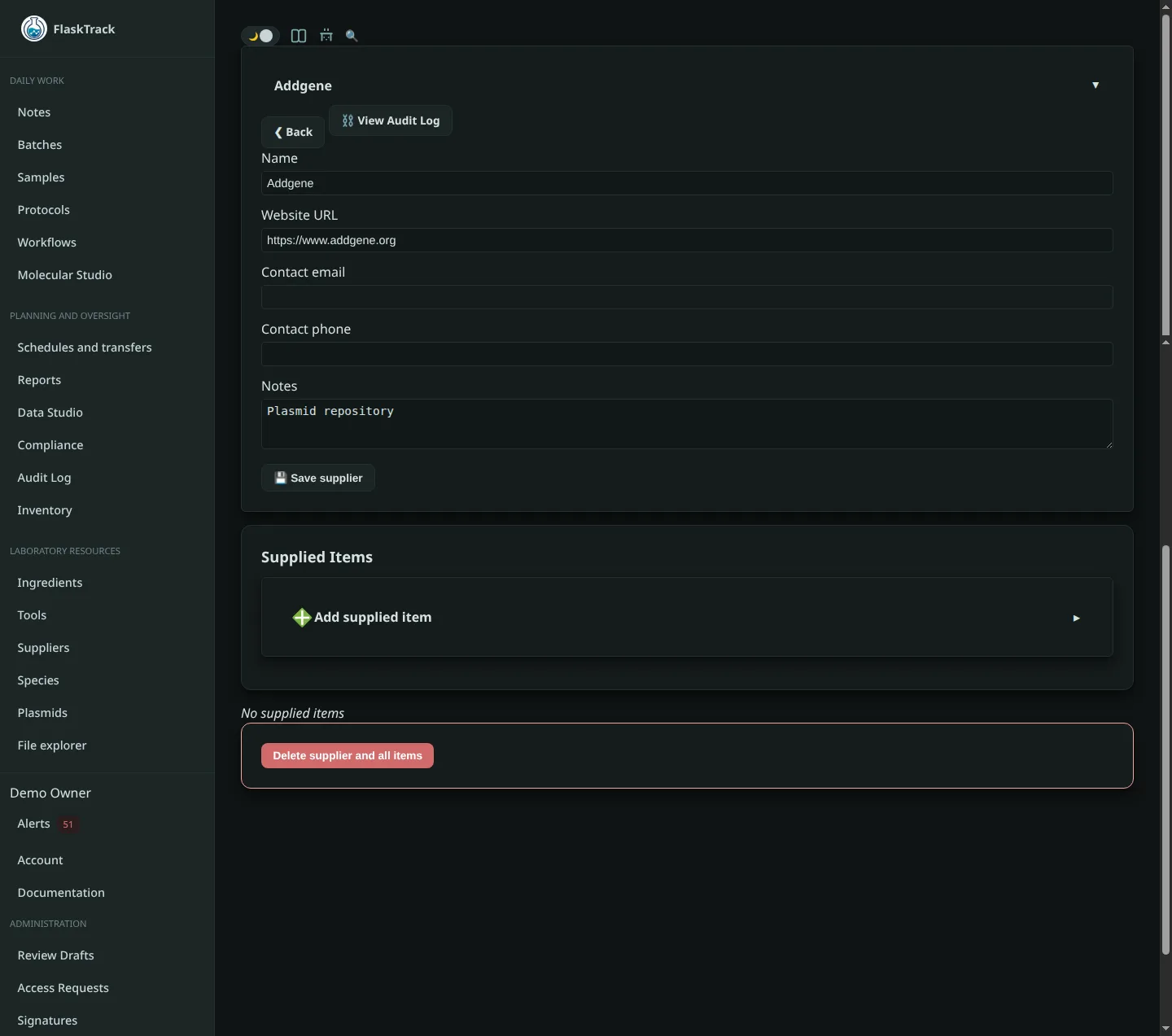
Suppliers
Suppliers represent the external vendors, manufacturers, distributors, and procurement sources that provide laboratory materials and operational resources used throughout Flask Track.
Supplier management connects laboratory execution with procurement, sourcing, inventory planning, and audit traceability.
By modeling suppliers and supplier-specific items separately from operational catalog entities, Flask Track allows organizations to maintain:
- Consistent scientific metadata
- Reusable operational resources
- Procurement visibility
- Vendor traceability
- Cost awareness
- Regulatory sourcing documentation
Suppliers help bridge the gap between laboratory execution and real-world operational logistics.
What Is a Supplier?
A supplier is an organization or vendor that provides laboratory materials, equipment, or operational resources.
Examples include:
- Chemical suppliers
- Equipment manufacturers
- Laboratory distributors
- Biological material providers
- Specialty reagent vendors
- Scientific wholesalers
- Internal procurement sources
Suppliers are organizational resources that can be reused across many catalog entities and operational workflows.
Why Suppliers Matter
Laboratory reproducibility depends not only on procedures, but also on consistent sourcing.
Different vendors may provide materials that vary in:
- Purity
- Quality
- Specifications
- Packaging
- Lead times
- Regulatory documentation
- Operational compatibility
Tracking supplier relationships improves:
- Reproducibility
- Procurement planning
- Cost visibility
- Operational standardization
- Audit defensibility
- Compliance traceability
Flask Track allows organizations to preserve these sourcing relationships directly within operational records.
Supplier Metadata
Each supplier contains shared organizational and procurement information.
Name
The supplier name is the primary human-readable identifier.
Examples:
- Sigma-Aldrich
- Thermo Fisher Scientific
- VWR
- PhytoTech Labs
- Local Equipment Distributor
Consistent naming improves:
- Procurement clarity
- Reporting consistency
- Audit readability
- Searchability
Website URL
Suppliers may include a website or catalog URL.
Examples include:
- Supplier homepage
- Product catalog portal
- Ordering systems
- Vendor storefronts
These links improve procurement workflows and operational accessibility.
Notes
Internal notes may be attached to suppliers.
Examples include:
- Preferred ordering instructions
- Contract information
- Vendor quality notes
- Internal procurement guidance
- Shipping considerations
- Regulatory observations
Notes are organizationally scoped and support operational coordination.
Supplier Items
Suppliers primarily exist to manage supplier-specific purchasable items.
A supplier item represents a vendor-specific product or purchasing entry linked to a standardized operational catalog entity.
This separation is critical because:
- One operational item may have many vendors
- Vendors may use different naming conventions
- Pricing and availability may vary
- Operational definitions should remain stable even when procurement sources change
Supplier items connect operational execution to real-world purchasing systems.
Linked Catalog Entities
Supplier items are linked to reusable catalog entities used throughout Flask Track.
Examples include:
- Ingredients
- Tools
- Species-related materials
- Plasmids
- Operational resources
This ensures:
- Standardized operational naming
- Reusable metadata
- Centralized traceability
- Consistent workflow references
Protocols and workflows reference the operational catalog entity, not the vendor-specific product entry.
Supplier Item Metadata
Each supplier item may contain detailed procurement and sourcing information.
Supplier-Specific Product Name
The vendor-specific item description or commercial product name.
Examples:
- Murashige and Skoog Basal Medium
- Orbital Shaker Model X200
- Plant Preservative Mixture™
- Sterile Culture Vessel Kit
Supplier-specific naming allows organizations to preserve purchasing accuracy without affecting standardized operational naming.
Product URL
Supplier items may contain direct links to product pages or ordering portals.
This improves:
- Procurement workflows
- Purchasing efficiency
- Vendor verification
- Operational accessibility
Catalog Number / SKU
Supplier catalog numbers identify the exact vendor product.
Examples include:
- SKU identifiers
- Manufacturer part numbers
- Vendor catalog codes
Catalog numbers improve:
- Ordering accuracy
- Audit traceability
- Reproducibility
- Vendor coordination
Pricing Information
Supplier items may contain pricing information including:
- Unit pricing
- Currency
- Packaging quantities
- Measurement units
- Concentration information
Pricing supports:
- Procurement planning
- Workflow cost estimation
- Operational budgeting
- Inventory review
Pricing data is informational and does not directly affect execution logic.
Lead Time
Supplier items may define expected delivery or procurement lead times.
Examples:
- Same-day availability
- 3–5 day shipping
- 6-week manufacturing lead time
Lead time visibility helps organizations plan:
- Batch scheduling
- Inventory replenishment
- Experimental timelines
- Long-running workflows
Notes
Supplier item notes may include:
- Storage instructions
- Vendor-specific handling guidance
- Packaging differences
- Regulatory restrictions
- Ordering constraints
- Procurement observations
These notes provide operational procurement context without affecting standardized execution definitions.
Preferred Suppliers
Supplier items may be marked as preferred sourcing options.
Preferred suppliers are typically:
- Highlighted throughout the interface
- Used as default procurement references
- Considered operationally trusted
- Reviewed for consistency or quality
Organizations often maintain preferred vendors to improve:
- Standardization
- Reproducibility
- Procurement efficiency
- Compliance confidence
In most cases, only one preferred supplier should exist per operational item.
Procurement & Operational Planning
Supplier systems support operational planning throughout the laboratory lifecycle.
Supplier data may be used for:
- Procurement estimates
- Workflow planning
- Cost analysis
- Inventory forecasting
- Batch preparation
- Vendor comparison
- Purchasing coordination
Because workflows and protocols reference standardized catalog entities, supplier data can be aggregated operationally across many procedures.
Relationship to Protocols & Workflows
Protocols and workflows reference operational catalog entities such as ingredients and tools.
Supplier items provide the procurement layer associated with those operational resources.
This separation allows organizations to:
- Change vendors without rewriting protocols
- Compare sourcing options
- Preserve operational consistency
- Maintain reproducibility independent of procurement systems
Operational execution remains stable even as purchasing relationships evolve.
Compliance & Traceability
Supplier relationships may have compliance significance.
Examples include:
- Approved vendor programs
- Restricted sourcing requirements
- Certified material providers
- Regulated equipment suppliers
- Traceable reagent sourcing
Supplier tracking improves:
- Audit defensibility
- Procurement traceability
- Material accountability
- Regulatory readiness
Supplier information may also support investigations or root cause analysis.
Audit Logging
Supplier activity is fully traceable.
Audit systems may record:
- Supplier creation
- Metadata updates
- Supplier item changes
- Pricing modifications
- Preferred vendor changes
- Procurement-related edits
This ensures sourcing decisions remain reviewable over time.
Editing & Deletion
Authorized users may:
- Create suppliers
- Edit supplier metadata
- Add or modify supplier items
- Update pricing and sourcing information
- Change preferred vendor status
Deletion should be approached carefully because supplier records may be referenced by:
- Procurement estimates
- Historical workflows
- Audit records
- Compliance systems
- Execution reports
In many cases, archival is preferred over permanent removal.
Best Practices
Recommended supplier management practices include:
- Use official vendor names
- Link directly to product pages where possible
- Keep pricing reasonably current
- Maintain accurate catalog numbers
- Mark preferred vendors intentionally
- Avoid duplicate supplier records
- Separate operational definitions from vendor-specific naming
- Periodically review outdated supplier items
Well-maintained supplier systems improve both operational coordination and long-term traceability.
Summary
Suppliers provide the procurement and sourcing layer for Flask Track’s operational catalog system.
By separating standardized laboratory entities from vendor-specific purchasing records, Flask Track enables organizations to:
- Maintain operational consistency
- Improve procurement visibility
- Preserve sourcing traceability
- Estimate operational costs
- Support audit readiness
- Coordinate laboratory purchasing
- Improve reproducibility across workflows
Suppliers are not simply vendor lists — they are part of the operational infrastructure that connects laboratory execution to real-world sourcing, estimating and procurement systems.