🧬 Flask Track Docs

Ingredients

Ingredients represent the chemical, biological, molecular, and operational materials used throughout laboratory workflows in Flask Track.

They provide a reusable, traceable, and compliance-aware catalog of materials referenced across:

Ingredients form a core part of the operational execution model and help ensure laboratory procedures remain reproducible, standardized, and auditable.


What Is an Ingredient?

An ingredient is any material or reagent used during laboratory execution.

Examples include:

Ingredients are defined once and reused throughout the organization.

This improves:


Why Ingredients Matter

Laboratory reproducibility depends heavily on material consistency.

Differences in:

can significantly impact experimental outcomes.

Flask Track models ingredients as structured operational entities rather than freeform text to improve execution consistency and long-term traceability.


Ingredient Metadata

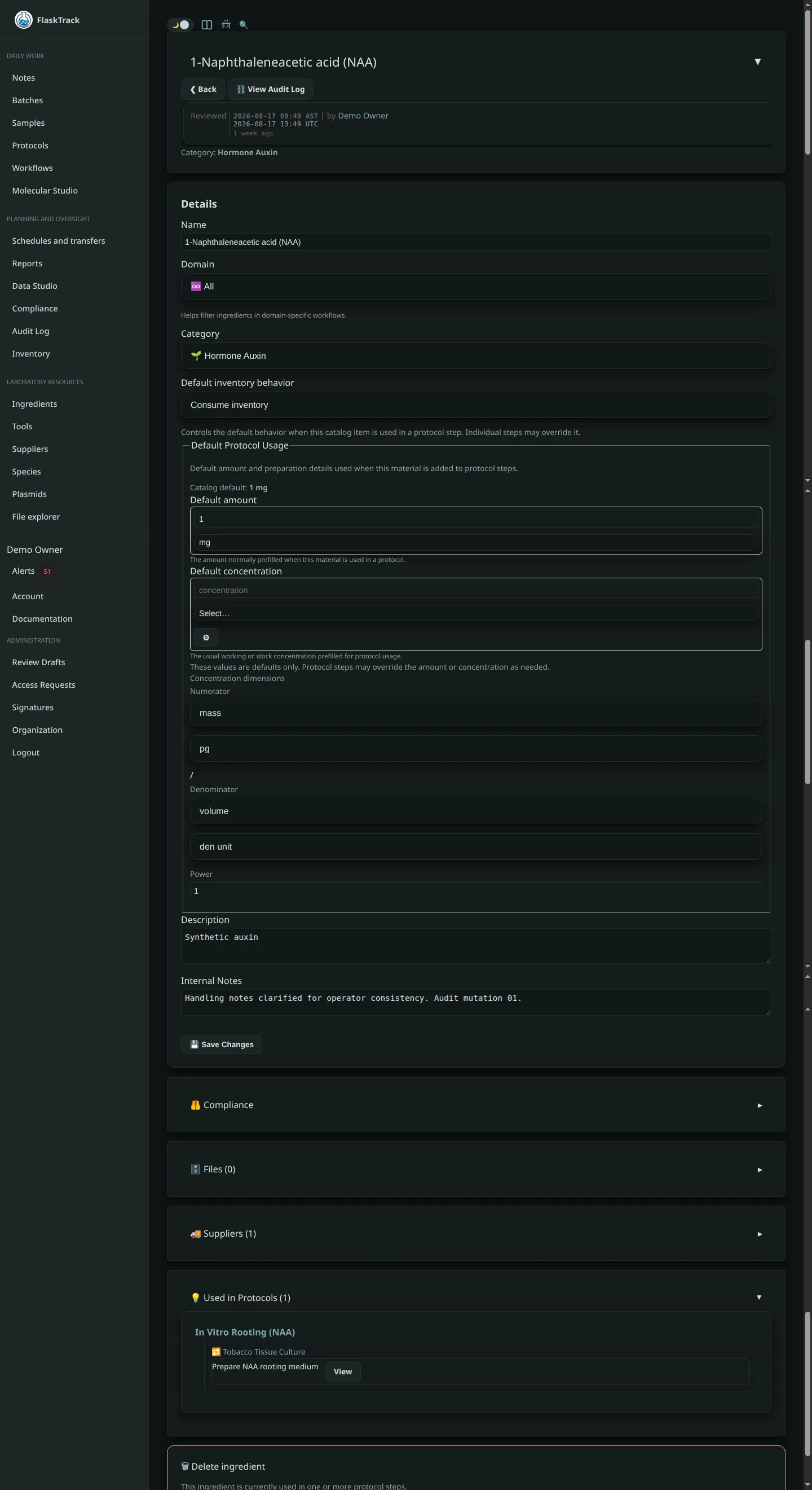
Each ingredient contains structured metadata used throughout operational workflows.


Name

The ingredient name acts as the primary operational identifier.

Examples:

Consistent naming improves:


Category

Ingredients may be categorized operationally.

Examples include:

Categories improve:


Description

Ingredients may contain detailed freeform descriptions.

Descriptions may include:

Descriptions improve operational clarity and scientific documentation.


Default Unit

Ingredients define a default operational measurement unit.

Examples include:

Default units are used during protocol authoring and execution tracking.

This improves consistency throughout workflows and reports.


Internal Notes

Ingredients may contain internal operational notes such as:

Internal notes help preserve operational knowledge and improve execution consistency.


Measurement & Concentration Tracking

Ingredients support structured measurement and concentration-aware operational tracking.

Examples include:

This enables laboratories to model:

Structured measurement systems improve reproducibility and reporting accuracy.


Files & Attachments

Ingredients support attached files and operational documentation.

Examples include:

Files become part of the permanent operational record associated with the ingredient.


Sequence-Aware Ingredients

Some ingredients may represent molecular or sequence-related biological assets.

Examples include:

When compatible sequence files are uploaded, Flask Track automatically enables integrated sequence visualization capabilities.


Integrated Sequence Viewer

Flask Track includes a built-in sequence viewer for compatible sequence files uploaded anywhere in the system.

The viewer may appear on:

Supported capabilities may include:

This allows rapid inspection of sequence data without external tooling.


Managing Sequence Files

Sequence-aware files may expose additional operational actions such as:

All file-related actions remain fully auditable.


Ingredient Suppliers & Procurement

Ingredients may be linked to supplier-specific procurement records.

Supplier integration allows organizations to track:

This connects operational execution directly to procurement and sourcing workflows.


Supplier Items

Supplier Items represent vendor-specific purchasable entries linked to a standardized ingredient definition.

This separation allows organizations to:

A single ingredient may have many supplier items representing different vendors or purchasing options.


Preferred Suppliers

Supplier items may be marked as preferred sourcing options.

Preferred suppliers help organizations:

Organizations may maintain multiple preferred suppliers where operationally appropriate.


Ingredient Usage in Protocols

Ingredients are primarily used within protocol steps.

Protocol steps may define:

Examples include:

Ingredient references become part of the operational execution history.


Workflow & Batch Integration

Ingredients are reused across:

This allows Flask Track to support:

Ingredient usage can be reconstructed across long-running operational histories.


Compliance & Regulatory Context

Ingredients may carry operational or regulatory significance.

Examples include:

Compliance systems may associate ingredients with:

This allows Flask Track to integrate material management directly into broader compliance workflows.


Auditability & Change Tracking

All ingredient-related activity is traceable.

Audit systems may record:

This supports:


Editing & Deletion

Authorized users may:

Deletion may be restricted when ingredients are referenced by:

In many cases, archival is preferred over permanent removal.


Typical Operational Workflow

A common ingredient lifecycle may include:

  1. Creating or importing the ingredient
  2. Defining operational metadata
  3. Attaching safety or sequence documentation
  4. Linking supplier items and pricing
  5. Using the ingredient within protocols
  6. Executing workflows and batches
  7. Preserving long-term audit and execution history

This creates a traceable operational chain from procurement through execution.


Best Practices

Recommended ingredient management practices include:

Well-maintained ingredient catalogs improve operational consistency across the organization.


Relationship to Protocols & Samples

Ingredients themselves do not execute work.

Instead:

This separation improves reusability, procurement flexibility, and operational traceability.


Summary

Ingredients provide the material and reagent management foundation within Flask Track.

By combining structured metadata, measurement-aware tracking, procurement integration, sequence support, compliance visibility, and audit traceability, Flask Track enables laboratories to:

Ingredients are more than catalog entries — they are foundational operational entities that connect laboratory materials to execution, compliance, reporting, and reproducible scientific workflows.