🧬 Flask Track Docs

Reports, Analytics & Data Lake Architecture

Flask Track includes a full reporting, analytics, and scientific data infrastructure designed to support operational visibility, regulatory traceability, scientific analysis, and large-scale laboratory reporting.

Unlike traditional laboratory systems that treat reports as static exports, Flask Track treats reports as structured, auditable operational records powered by a centralized analytical data platform.

The reporting architecture combines:

This allows organizations to move seamlessly from day-to-day laboratory execution to enterprise-scale operational analytics.


Reporting Philosophy

Flask Track treats reporting as part of the operational execution system itself.

Reports are not simply exported summaries.

They are:

This creates significantly stronger operational integrity than spreadsheet- or export-based reporting systems.


High-Level Reporting Architecture

The reporting stack consists of several connected layers:

  1. Operational Execution Data
  2. Event & Form Capture
  3. Data Lake Storage
  4. Apache Arrow & Parquet Serialization
  5. Apache Flight Query Infrastructure
  6. Dynamic SQL Analytics
  7. System Reports
  8. Report Builder
  9. Export & Audit Systems

Together, these systems create a scalable analytical and compliance-aware reporting platform.


Operational Data Sources

Reports derive directly from real laboratory execution.

Examples of operational data include:

This ensures reports reflect actual execution history rather than manually reconstructed summaries.


Structured Event Architecture

Flask Track captures operational activity using structured events and execution records.

Examples include:

These events become the foundational analytical dataset powering the reporting system.


The Data Lake

Flask Track includes a centralized analytical data lake for long-term operational storage and querying.

The data lake stores structured operational data in analytical formats optimized for:

The data lake acts as the analytical backbone of the platform.


Apache Flight Server

Flask Track includes a dedicated Apache Flight server for analytical querying and report execution.

Apache Flight provides:

This enables:

without directly querying operational transactional databases.


Dynamic SQL Analytics

Flask Track includes a SQL-powered report builder and analytics interface.

Authorized users can:

The reporting layer supports both:


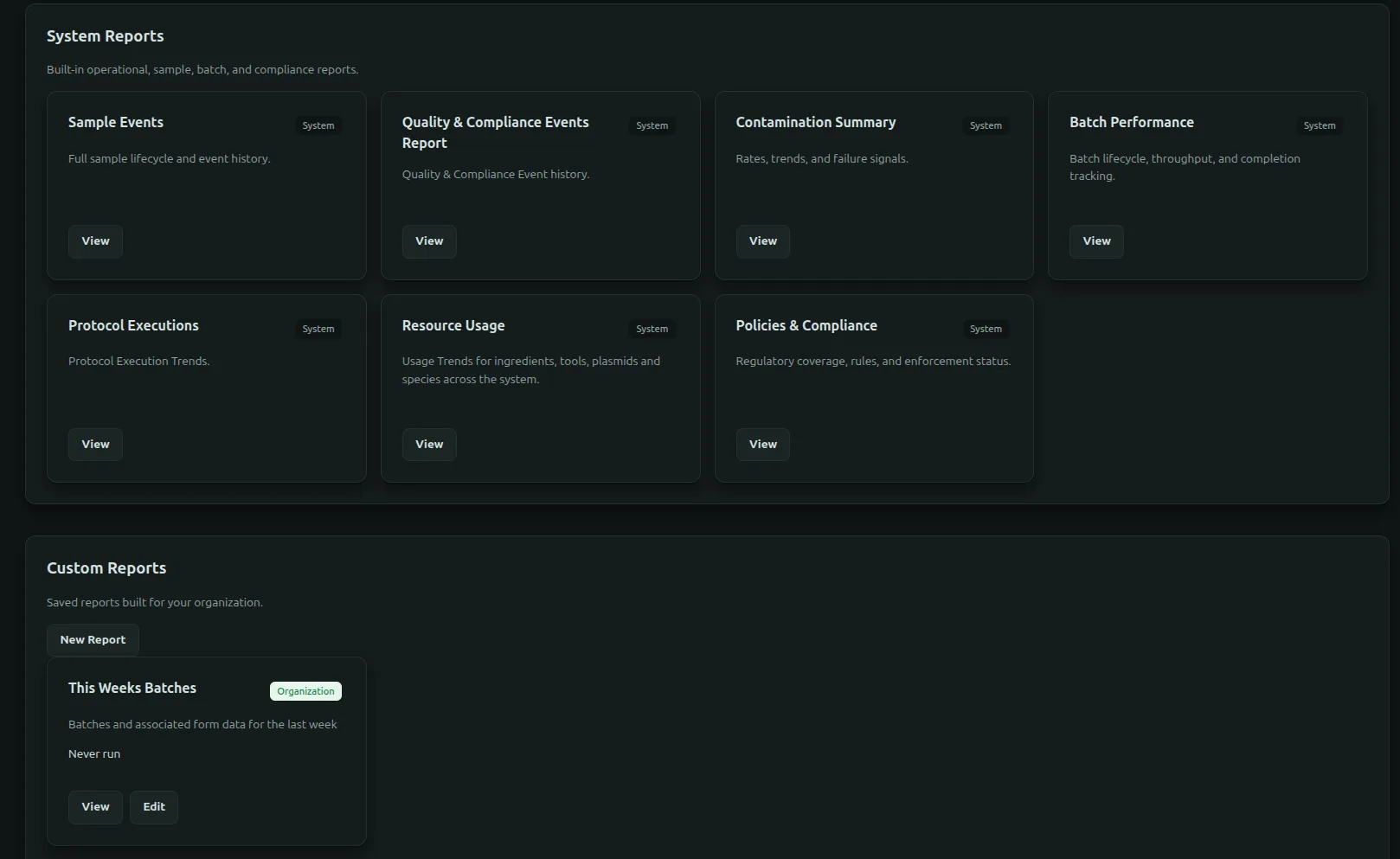
Built-In System Reports

Flask Track includes prebuilt operational and compliance reports covering many common laboratory workflows.

Examples include:

These reports are fully integrated into operational execution history.


Scientific Workflow Reporting

The platform includes domain-aware reporting for specialized laboratory workflows.

Examples include:

Tissue Culture


Fungus Cultivation


Agrobacterium Workflows

Scientific reporting remains directly connected to execution history and operational context.


Compliance & Quality Reporting

The reporting system also supports compliance-aware operational reporting.

Examples include:

These reports support:


Structured Form Data

Protocol steps may include structured data capture forms.

Examples include:

These forms are automatically written into the analytical data lake and become queryable through the reporting system.


Dynamic Analytical Tables

Flask Track dynamically generates analytical datasets for structured operational forms.

This allows organizations to query:

without manual schema construction.


Report Builder

The Report Builder provides an interactive analytics environment for laboratory users.

Capabilities include:

The report builder is powered directly by the Apache Flight analytical infrastructure.


Report Builder Use Cases

Common use cases include:

This allows organizations to perform operational analytics without external BI tooling.


Data Export Formats

Reports and analytical queries may be exported as:

Exports preserve operational context and analytical structure.

This improves interoperability with:


Immutable Reporting Records

Finalized reports become immutable operational artifacts.

Finalized reports:

This improves audit defensibility and regulatory traceability.


Report Lifecycle

Reports generally follow a lifecycle such as:

  1. Created
  2. Updated dynamically
  3. Reviewed
  4. Finalized
  5. Locked immutably

This allows organizations to distinguish between:


Auditability of Reports

All report activity is audited.

Examples include:

Audit records preserve:

This creates strong traceability for analytical workflows.


Separation of Operational & Analytical Systems

Flask Track separates:

System Purpose
Transactional Database Real-time operational execution
Data Lake & Flight Server Analytical reporting and querying

This architecture improves:

without impacting operational execution systems.


Long-Term Historical Analytics

Because operational data is continuously written into the data lake, organizations can perform long-term analysis such as:

Historical analytics remain available across years of operational execution.


API & Automation Integration

The analytical infrastructure also supports external integrations.

Authorized systems may:

This allows Flask Track to integrate with:


Scientific Reproducibility

Because reports derive directly from execution history and structured operational data, Flask Track improves scientific reproducibility by preserving:

This creates significantly stronger experimental traceability.


Operational Visibility

The reporting system provides visibility across:

Organizations gain a unified analytical view of operational activity.


Design Philosophy

The reporting architecture is designed to be:

The goal is to eliminate disconnected reporting silos and create a unified operational and analytical platform.


Key Assurance Statement

Reports in Flask Track are not disconnected exports or manually reconstructed summaries.

They are:

This allows organizations to move from execution to analytics without losing traceability or historical integrity.


Summary

Flask Track combines operational execution, structured scientific data capture, analytical infrastructure, and compliance-aware reporting into a unified platform.

By integrating:

Flask Track enables organizations to perform scalable, traceable, and audit-ready laboratory analytics directly from real execution history rather than disconnected reporting systems.