🧬 Flask Track Docs

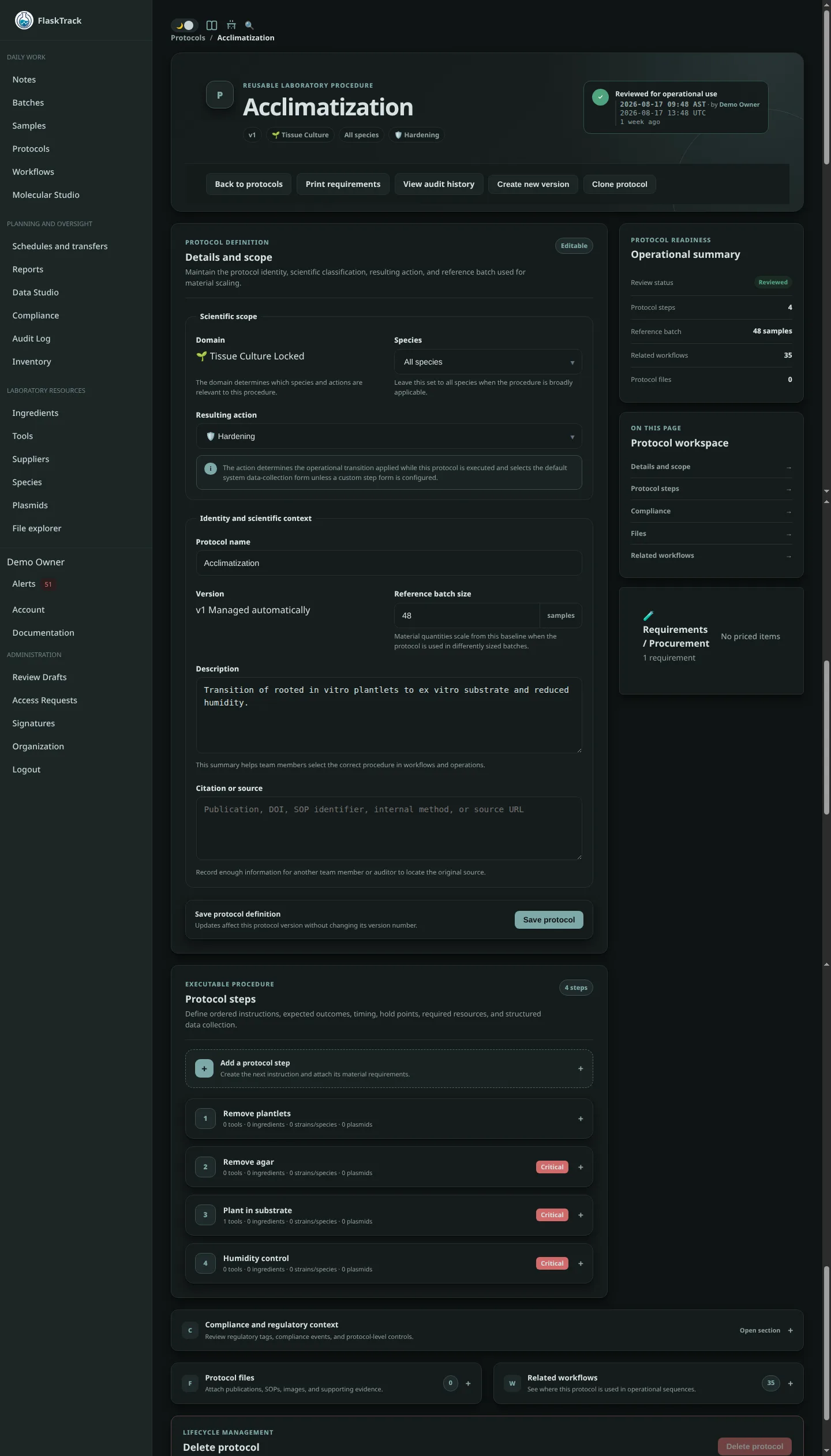
Protocol Detail & Editor

Protocols define how laboratory work is performed within Flask Track.

They act as structured, versioned, and auditable operational procedures that drive workflows, batch execution, compliance enforcement, and laboratory reproducibility.

Protocols are the foundation of execution throughout the platform.

They describe:

Protocols may represent:


Protocol Overview

The Protocol Detail View is both:

Protocols are designed to support:

Protocols may be reused across multiple workflows, batches, and operational environments.


Protocol Metadata

The top section of the protocol defines the identity, scope, and operational classification of the procedure.

This metadata controls how protocols are:


Domain

The domain defines the biological or operational context for the protocol.

Examples may include:

Domains help organize procedures and improve workflow compatibility.


Species (Optional)

Protocols may optionally target a specific species.

Species targeting allows organizations to:

If no species is specified, the protocol may be reused more broadly.


Action

The action defines the operational purpose of the protocol.

Examples include:

Actions improve operational consistency and support workflow automation, reporting, and analytics.


Name & Description

Protocols include human-readable naming and descriptive metadata used throughout the platform.

These values appear in:

Clear naming improves operational readability and auditability.


Versioning & Status

Protocols are versioned and may move through operational lifecycle states such as:

Versioning allows laboratories to:

Execution history remains linked to the exact protocol version used during execution.


Related Workflows

The Related Workflows section displays workflows that currently reference the protocol.

This provides operational visibility into:

Protocols may:

This reuse model improves consistency across laboratory operations.


Protocol Steps

Protocols consist of ordered protocol steps.

Each step represents a single operational unit of work that can be:

Step-level modeling enables highly traceable laboratory execution.


Step Structure

Each protocol step defines the operational details required to perform that portion of work.


Step Title

A concise human-readable identifier for the step.

Examples:

Clear step naming improves execution clarity and audit readability.


Instructions

Steps support rich Markdown-based instructions.

Instructions may include:

Instructions are preserved as part of the permanent execution reference.


Step Order

Steps execute sequentially according to their defined order.

The protocol editor allows laboratories to build complex multi-stage procedures while preserving deterministic execution structure.

Execution systems use step order to:


Scheduling & Timing

Protocol steps support advanced operational timing configuration.

Timing systems help laboratories coordinate execution across batches and workflows.

Supported timing concepts may include:

This enables modeling of real laboratory processes where execution timing is operationally significant.


Duration & Timing Windows

Steps may define:

Examples:

Timing data becomes part of the permanent execution history.


Environmental Conditions

Protocol steps may define expected environmental conditions.

Examples include:

Environmental modeling improves:

These conditions are displayed during execution and preserved in execution records.


Tools & Equipment

Steps may require one or more tools or pieces of equipment.

Examples include:

Tool definitions may include:

Tool references improve operational traceability and procedural standardization.


Ingredients & Materials

Protocol steps may include required ingredients or reagents.

Examples include:

Ingredient entries may define:

Ingredient usage becomes part of the operational execution record and may be referenced during reporting or compliance review.


Structured Data Capture

Protocol steps may optionally require structured data collection during execution.

Examples include:

Structured forms improve:

Captured data becomes permanently associated with the execution history.


Compliance Integration

Protocols may contain compliance-aware operational requirements.

Examples include:

Compliance rules may affect whether a protocol or step can proceed during execution.

This ensures compliance becomes part of operational execution rather than a disconnected administrative process.


Files & Attachments

Protocols and steps may include attached operational resources such as:

Attached files improve execution clarity and preserve procedural context.


Editing & Maintaining Protocols

Protocols are expected to evolve over time.

The editor allows authorized users to:

Versioning preserves historical traceability while allowing operational improvement.


Approval Workflow

Organizations may require approval before protocols can be used operationally.

Typical lifecycle progression includes:

  1. Drafting
  2. Scientific review
  3. Compliance review
  4. Approval
  5. Production use
  6. Archival or replacement

Only approved protocols should be used in regulated or production environments.


Protocol Reuse & Standardization

Protocols are intentionally reusable.

A single protocol may:

This reuse model improves:


Archival & Deletion

Protocols that have been:

may become protected from deletion.

In many cases, archival is preferred over permanent removal.

This preserves:


Who Uses This Page?

Scientists

Scientists use protocols to:


Technicians

Technicians reference protocols during operational execution.

Protocols provide:


Administrators

Administrators manage:


Auditors & Reviewers

Auditors use protocols to verify:

Protocols serve as the authoritative definition of how work is intended to be performed.


Summary

Protocols are the operational backbone of Flask Track.

They transform laboratory knowledge into structured, executable, traceable procedures that support:

By combining structured execution logic, environmental modeling, materials tracking, compliance integration, and versioned procedural control, Flask Track protocols provide a modern foundation for scalable laboratory operations.