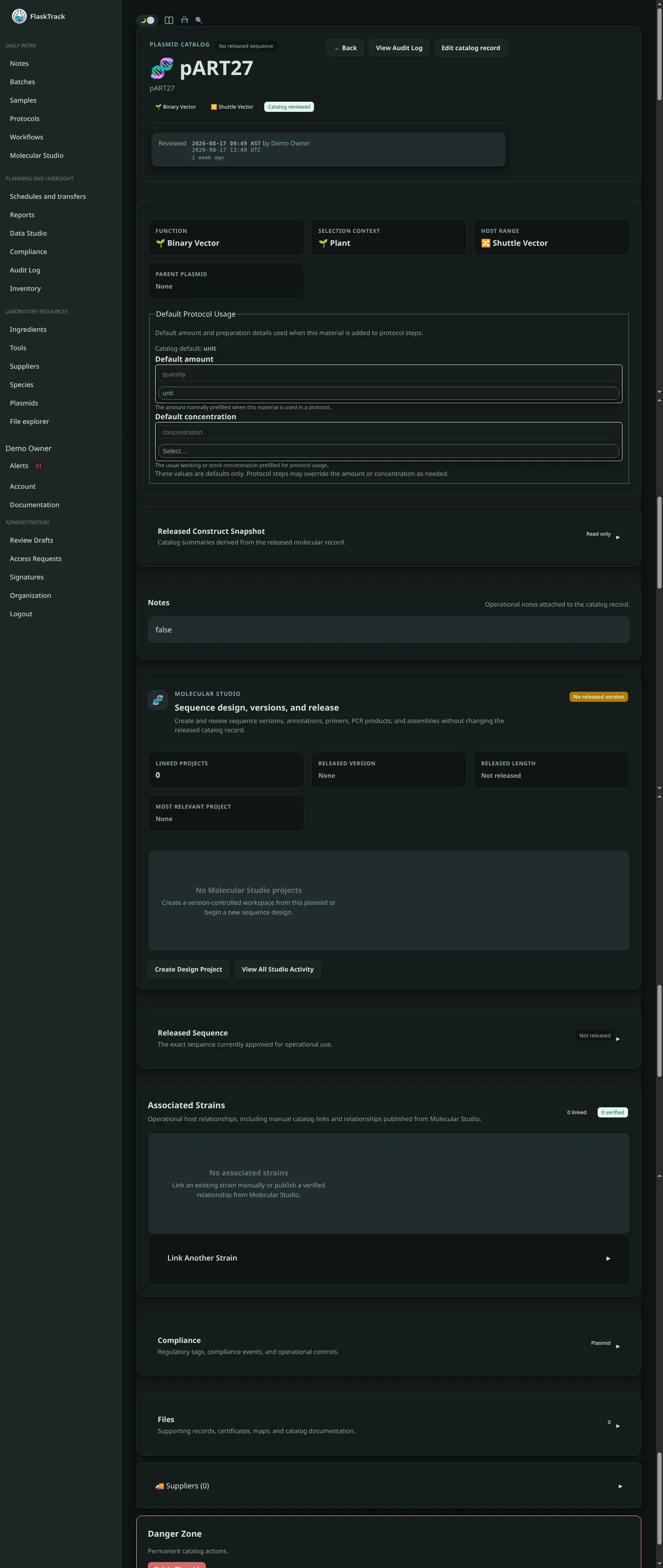
Plasmids
Plasmids represent engineered genetic constructs used throughout transformation, expression, selection, and genetic modification workflows within Flask Track.
They provide a structured, traceable, and compliance-aware system for managing recombinant DNA constructs across:
- Protocols
- Workflows
- Agrobacterium strains
- Transformation events
- Batches
- Samples
- Compliance systems
- Sequence records
Plasmids are modeled as first-class biological entities to ensure reproducibility, operational consistency, and long-term auditability.
What Is a Plasmid?
A plasmid is an engineered DNA vector used for biological transformation, expression, selection, or genetic modification.
Plasmids may contain:
- Vector backbones
- Selectable markers
- Reporter genes
- Promoters
- Terminators
- Regulatory sequences
- Cloning sites
- Transformation elements
- Custom engineered inserts
Examples include:
- pCAMBIA vectors
- pBIN vectors
- Binary vectors
- Expression constructs
- CRISPR-associated plasmids
- Transformation helper constructs
Plasmids are reusable operational and biological resources referenced throughout laboratory workflows.
Why Plasmids Matter
Transformation and genetic engineering workflows depend heavily on accurate construct tracking.
Improper plasmid management can lead to:
- Experimental inconsistency
- Incorrect selection conditions
- Misidentified transformation events
- Reproducibility failures
- Compliance risks
- Traceability gaps
Flask Track allows laboratories to centrally manage plasmid definitions and associate them directly with execution history.
Plasmid Metadata
Each plasmid contains structured metadata used across the platform.
Name
The plasmid name acts as the primary operational identifier.
Examples:
- pBI101
- pCAMBIA1301
- pBIN19
- CRISPR-Cas9 Expression Vector
Consistent naming improves:
- Experimental readability
- Workflow consistency
- Reporting accuracy
- Audit traceability
Plasmid names should remain stable over time whenever possible.
Backbone
The backbone defines the underlying vector system used for the construct.
Examples:
- pCAMBIA
- pBIN
- pGreen
- Binary Vector Systems
Backbone tracking helps laboratories understand:
- Vector compatibility
- Cloning context
- Selection behavior
- Transformation systems
Backbone metadata improves reproducibility and experimental interpretation.
Selectable Marker
Selectable markers define the resistance or selection systems encoded by the plasmid.
Examples include:
- Kanamycin resistance
- Hygromycin resistance
- Spectinomycin resistance
- Basta resistance
Marker tracking is operationally important because selection conditions directly affect transformation and regeneration workflows.
Reporter Genes
Plasmids may optionally define reporter genes or expression markers.
Examples include:
- GFP
- GUS
- RFP
- Luciferase
Reporter metadata improves:
- Experimental visibility
- Screening workflows
- Reporting clarity
- Transformation tracking
Notes
Plasmids may contain freeform operational or biological notes.
Examples include:
- Construct history
- Experimental caveats
- Regulatory observations
- Cloning details
- Transformation guidance
- Usage restrictions
Notes help preserve institutional and experimental context.
Construct Metadata
Plasmids may also include additional construct-level biological metadata.
Examples may include:
- Promoters
- Terminators
- Origins of replication
- Host range
- Cloning methods
- Selection systems
- Functional classifications
- Topology information
- Parent plasmid relationships
This allows Flask Track to model plasmids as structured biological entities rather than simple file attachments.
Sequence Files & Genetic Data
Plasmids support attached sequence and construct files.
Supported files may include:
- FASTA
- FASTQ
- GenBank
- Sequence maps
- Annotation files
- Construction diagrams
- Alignment references
Sequence files become part of the permanent plasmid record.
Integrated Sequence Viewer
When compatible sequence files are attached, Flask Track enables an integrated sequence visualization system.
Features may include:
- Circular plasmid views
- Linear sequence views
- Base position tracking
- Sequence length visualization
- Annotation overlays
- Consistent sequence rendering throughout the platform
This allows users to review sequence context directly within operational workflows.
The same viewer may also appear in other sequence-aware areas of the platform.
Agrobacterium Strain Associations
Plasmids may be linked to one or more Agrobacterium strains.
These relationships define biologically and operationally compatible transformation pairings.
Examples:
| Plasmid | Strain |
|---|---|
| pCAMBIA1301 | EHA105 |
| pBIN19 | GV3101 |
| Expression Vector A | LBA4404 |
These associations improve transformation workflow consistency and operational validation.
Strain-Specific Selection Context
Each plasmid–strain relationship may include additional metadata such as:
- Selectable markers
- Selection conditions
- Operational notes
- Compatibility guidance
This is important because:
- Different strains may require different antibiotics
- Selection systems may vary operationally
- Transformation conditions may differ between strain pairings
Explicit relationship tracking improves reproducibility and execution accuracy.
Transformation Workflow Integration
Plasmids are deeply integrated into transformation and genetic modification workflows.
They may be referenced by:
- Transformation protocols
- Co-cultivation steps
- Species defaults
- Batch execution
- Sample events
- Structured forms
- Compliance systems
Plasmids may also be:
- Automatically suggested
- Pre-filled during execution
- Validated against species or workflow rules
This reduces operational errors and improves standardization.
Species Defaults & Workflow Automation
Species may define default plasmids used during transformation workflows.
These defaults help streamline:
- Batch creation
- Experimental setup
- Transformation events
- Protocol execution
Defaults remain fully overridable during actual execution.
This balances operational efficiency with experimental flexibility.
Files & Operational Documentation
Plasmids may also include additional operational or compliance documentation.
Examples include:
- Construction notes
- SOPs
- Transformation references
- Regulatory documentation
- Literature references
- Experimental validation data
Documentation remains linked to the plasmid throughout operational history.
Compliance & Regulatory Context
Plasmids may carry compliance significance depending on organizational or regulatory requirements.
Examples include:
- GMO workflows
- Recombinant DNA handling
- Restricted constructs
- Biosafety requirements
- Export-controlled material
- Regulated transformation systems
Compliance metadata may influence:
- Workflow restrictions
- Approval requirements
- Audit visibility
- Authorization systems
- Reporting procedures
Flask Track integrates plasmid management directly into broader compliance workflows.
Auditability & Traceability
All plasmid-related activity is traceable.
Audit systems may record:
- Plasmid creation
- Metadata updates
- Sequence uploads
- Strain linking and unlinking
- Compliance-related modifications
- Operational usage references
This allows organizations to reconstruct construct history over time.
Plasmids in Execution History
Plasmids may appear throughout operational execution records.
Examples include:
- Transformation events
- Sample timelines
- Protocol execution history
- Batch records
- Compliance events
- Structured data capture
This ensures genetic construct usage remains fully traceable across laboratory workflows.
Editing & Deletion
Authorized users may:
- Create plasmids
- Upload sequence files
- Link compatible strains
- Update metadata
- Modify operational references
Deletion may be restricted when plasmids are referenced by:
- Samples
- Batches
- Workflows
- Compliance records
- Historical execution events
In many cases, archival is preferred over permanent removal.
Best Practices
Recommended plasmid management practices include:
- Maintain stable naming conventions
- Avoid duplicate construct entries
- Upload canonical sequence files
- Document selectable markers clearly
- Track compatible strains explicitly
- Attach meaningful operational notes
- Record construct lineage when relevant
- Review outdated constructs periodically
Well-maintained plasmid records improve reproducibility, transformation consistency, and audit readiness.
Relationship to Workflows & Samples
Plasmids themselves do not execute work.
Instead:
- Protocols define transformation procedures
- Workflows organize execution progression
- Batches instantiate operational runs
- Samples represent biological execution units
- Plasmids provide the genetic construct context used throughout execution
This separation allows Flask Track to maintain reusable operational workflows while preserving precise biological traceability.
Summary
Plasmids provide the genetic construct management layer within Flask Track.
By combining structured biological metadata, sequence management, strain compatibility tracking, workflow integration, compliance visibility, and audit traceability, Flask Track enables laboratories to:
- Standardize construct tracking
- Improve transformation reproducibility
- Maintain GMO traceability
- Streamline transformation workflows
- Preserve sequence-linked operational history
- Support regulated laboratory environments
- Improve long-term experimental accountability
Plasmids are more than sequence files — they are operational biological entities that connect genetic engineering workflows to execution, compliance, and traceable laboratory history.