Instrument pipeline security and data handling
Instrument connectivity crosses the boundary between laboratory networks and FlaskTrack. Configure agents and connectors as controlled infrastructure rather than ordinary desktop utilities.
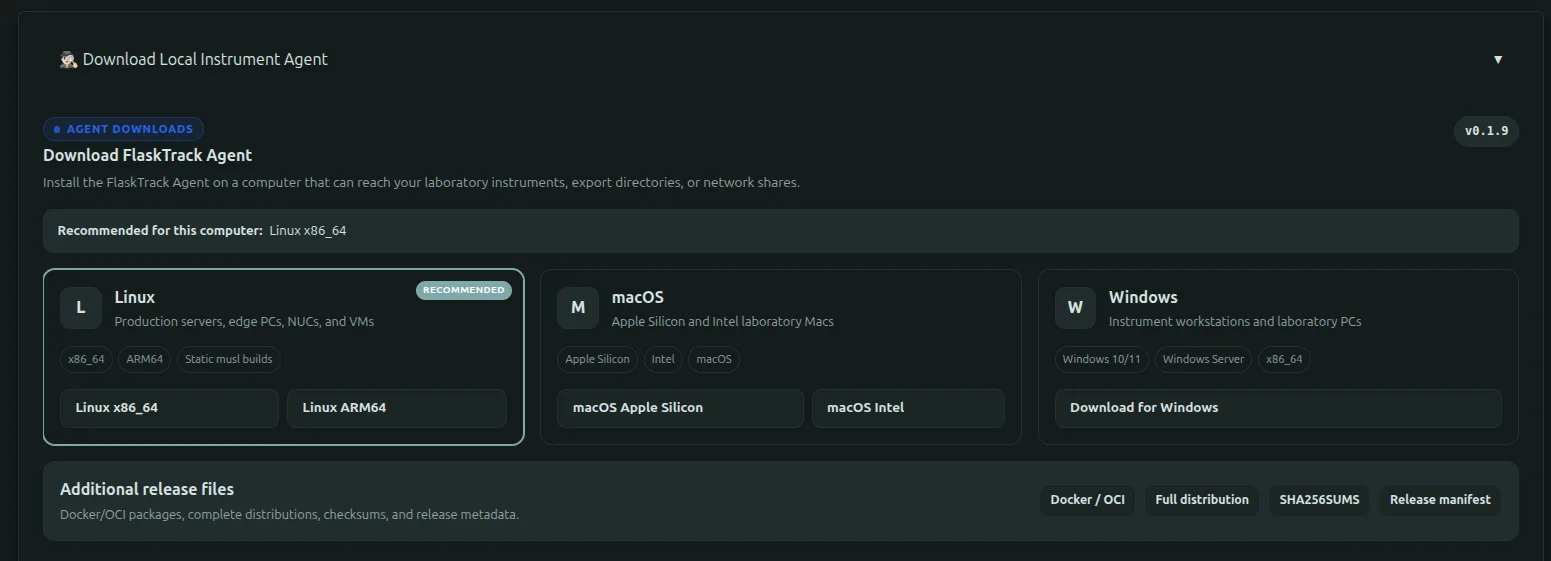
Outbound connection model
For a FlaskTrack cloud deployment, the Instrument Agent initiates the connection to FlaskTrack.
This avoids requiring:
- public SMB or NFS shares;
- inbound firewall rules to laboratory workstations;
- public exposure of private instrument APIs;
- direct FlaskTrack cloud access to private RFC1918 addresses.
Agent credentials
Instrument Agent keys begin with:
Treat the key like any other machine credential.
Do not:
- commit it to Git;
- paste it into tickets or public chat;
- include it in screenshots;
- reuse a revoked key;
- share one key between unrelated machines when separate agents can be created.
Rotate a key when the machine role changes or the credential may have been disclosed.
Configuration file permissions
On Unix-like systems, restrict the bootstrap configuration so ordinary users cannot read the machine key.
The supplied agent initialization writes restrictive permissions on supported Unix platforms, and the supplied Windows installer restricts the installed configuration ACL to SYSTEM and Administrators.
Your local security policy remains authoritative.
HTTPS
Use HTTPS for production FlaskTrack endpoints.
The agent accepts loopback HTTP for local development. Do not enable insecure HTTP for production SaaS traffic.
No FlaskTrack credential is sent to vendor endpoints
Local vendor connections such as Opentrons are separate from the FlaskTrack upload connection. The FlaskTrack agent key is intended for FlaskTrack machine authentication and should not be forwarded to instrument/vendor URLs.
Network-share credentials
Do not place SMB/NFS usernames or passwords in general connector settings unless a specific approved integration explicitly requires it.
Prefer operating-system or infrastructure-managed mounts and service identities.
Raw artifacts
The agent calculates a SHA-256 fingerprint before upload, and FlaskTrack preserves artifact identity as part of the ingestion record.
Keep the source artifact and parsed result conceptually separate:
A parsed run is not a replacement for the original source artifact.
Local spool
The agent stages pending artifacts in a local spool before upload. Protect the state directory according to the sensitivity of the laboratory data being processed.
Consider:
- filesystem permissions;
- full-disk encryption;
- backup policy;
- endpoint security;
- local retention procedures;
- secure decommissioning of retired agent hosts.
Dead-letter data
Artifacts rejected permanently by the server may remain under the agent's dead-letter directory for investigation.
Review and clear these records under an approved procedure; do not assume they disappear automatically.
Review-controlled runs
FlaskTrack locks mappings after instrument-run review begins. Accepted and Rejected runs remain review-locked.
This helps prevent a reviewed scientific result from changing because a source mapping was edited afterward.
Electronic signatures
Where instrument run acceptance or rejection uses FlaskTrack electronic signatures, signature authorization is tied to the controlled run decision. Rejection reasons are part of the signed decision payload.
Operational recommendations
For production laboratories:
- use a dedicated or controlled machine identity for the agent;
- restrict who can administer that machine;
- keep the agent binary and configuration under change control appropriate to your environment;
- document which instruments and shares each agent can access;
- review agent and connector errors;
- rotate credentials during machine replacement or suspected compromise;
- verify parser changes before production use;
- preserve objective evidence when the pipeline is part of a regulated workflow.