Assemblies
An assembly describes how multiple sequence fragments are intended to become a new molecular construct.
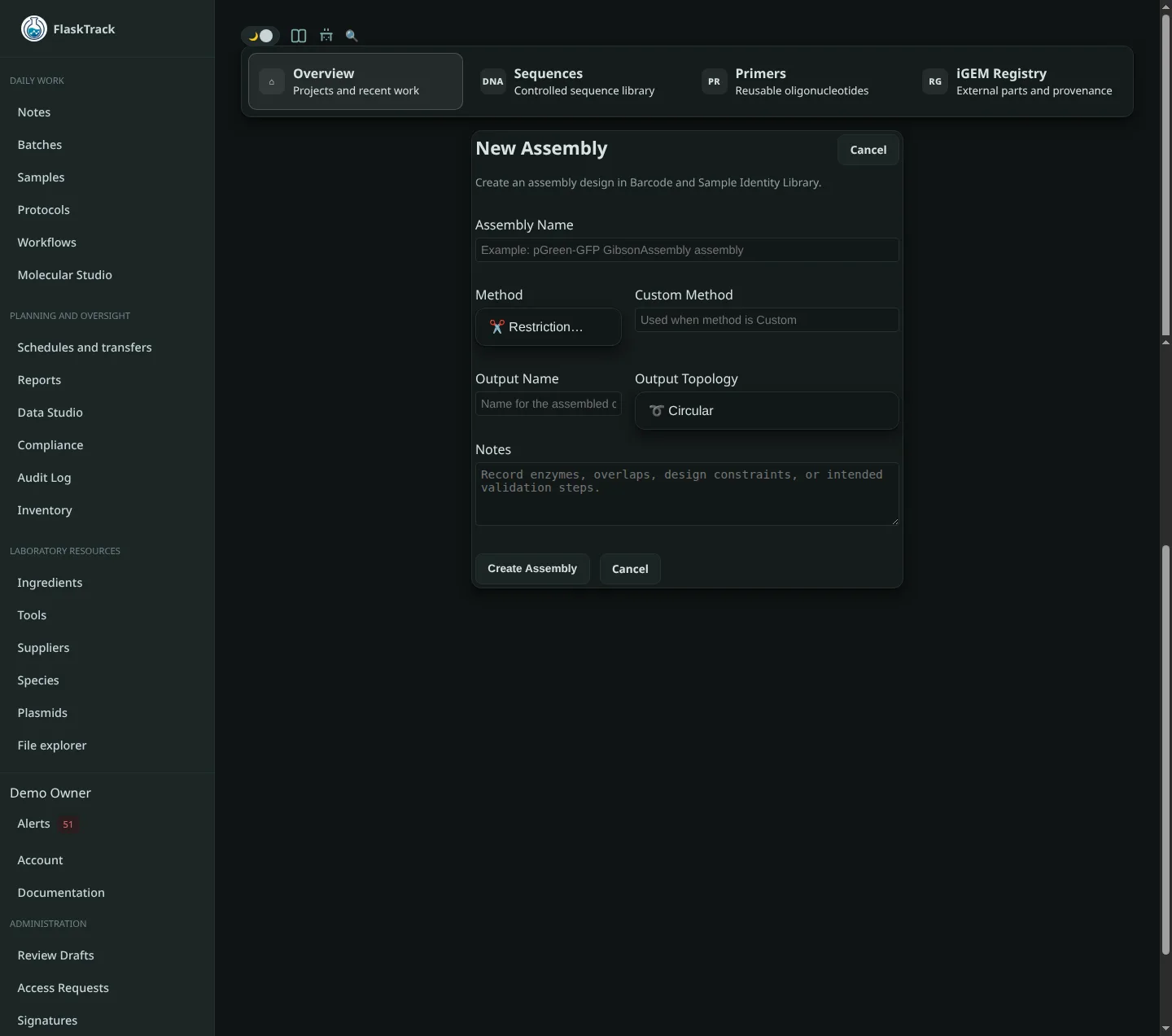
Typical assembly methods
Depending on your configuration, methods can include Gibson assembly, Golden Gate, restriction and ligation, PCR-based assembly, concatenation, site-directed mutagenesis, and custom methods.
Assembly fragments
Each fragment references an exact sequence version.
The assembly records fragment order, start and end coordinates, strand or orientation, left overhang, and right overhang.
Simulation
Use Simulate assembly to create a computational candidate from the selected fragments.
Review fragment order, sequence orientation, overhangs, resulting length, output topology, and warnings.
Simulation does not modify the operational plasmid catalog by itself.
Creating an output plasmid
A project can ultimately produce a plasmid-backed output.
Treat creation of a catalog plasmid as a separate lifecycle step from assembly simulation.
A draft assembly output should be reviewed before its sequence is approved and released.