Design projects
A Molecular Studio project is a controlled workspace for one molecular design objective.
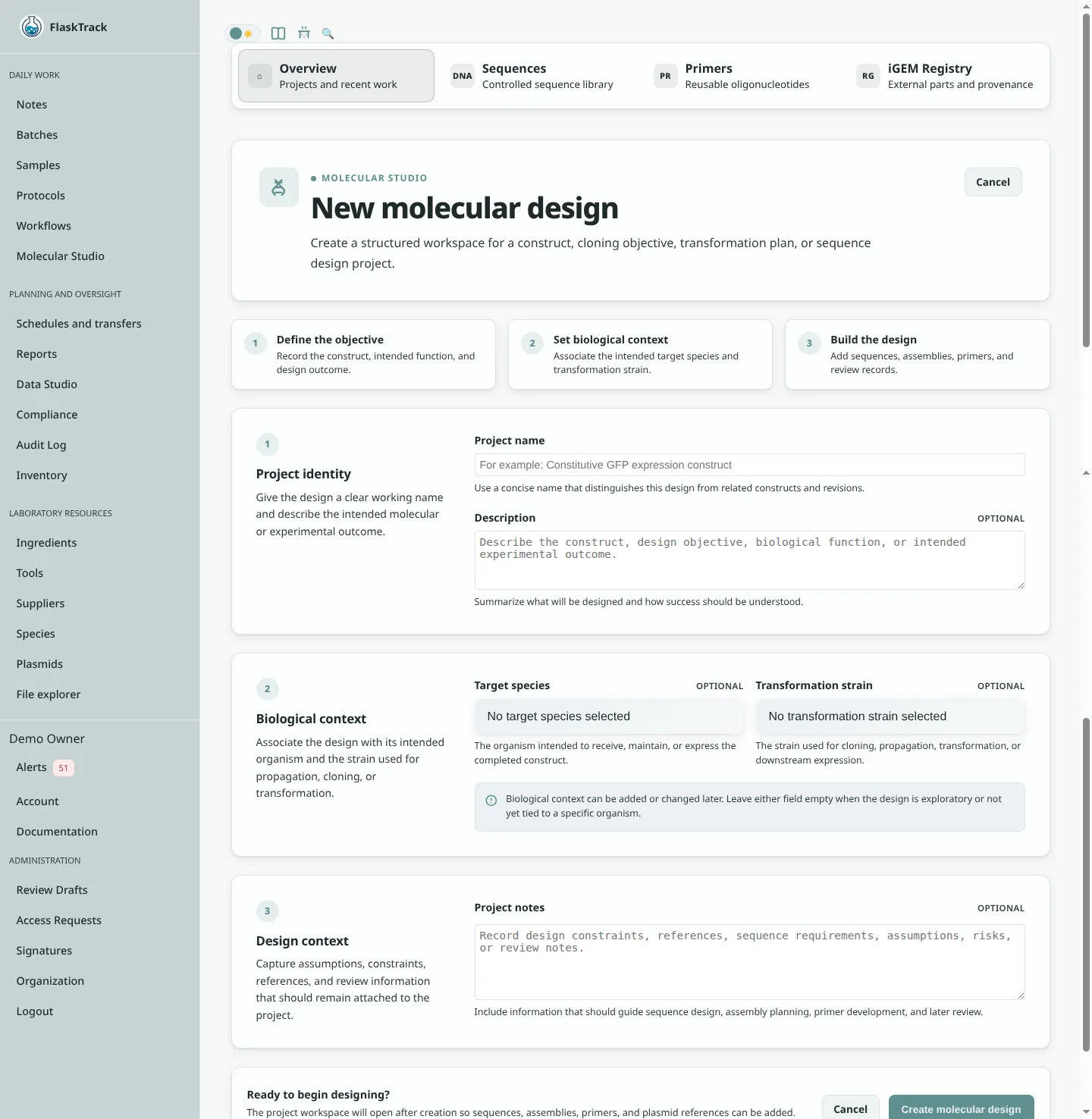
Examples include:
- building a new expression plasmid;
- replacing a promoter;
- preparing a construct for transformation;
- assembling an existing backbone with a new insert;
- evaluating primer or PCR options;
- creating a revised version of an existing construct.
Project context
A project can include:
Target species
The organism the design is intended to affect, transform, edit, or express within.
Transformation strain
A strain used to carry, propagate, or deliver a construct.
Transformation method
The intended transformation approach when applicable.
Sequences
Versioned molecular records attached to the project.
Assemblies
Ordered plans for combining sequence fragments.
Output
The molecular result the project is intended to produce.
Project status
Project status communicates where the design is in its lifecycle. A project being present does not mean its output has been approved or released.
Use the project page as the engineering workspace. Use the catalog for operational records.
Sequence roles
Sequences attached to projects have explicit roles such as:
- Working Sequence
- Source Sequence
- Assembly Input
- Assembly Output
- Reference
Roles describe how a sequence participates in the project. They do not change the underlying sequence version.
Design intent versus operational state
A target species or transformation strain on a project is design intent.
It means:
This project plans to use this organism or strain.
It does not mean:
This construct was successfully created or transformed into this strain.
Operational plasmid–strain relationships are recorded separately after the design reaches the catalog.